 Complos
Florida HB 1379 + HB 1417: The 2026 Roadmap to BMAP Compliance Before 2030
Complos team · May 25, 2026
FL HB 1379 + HB 1417 in 2026: BMAP-zone scope, the 2030 nitrogen-reducing-system cliff, FDEP-approved NRS list, $10K-$20K SoSeF grants, and the 2.6M-parcel timeline.
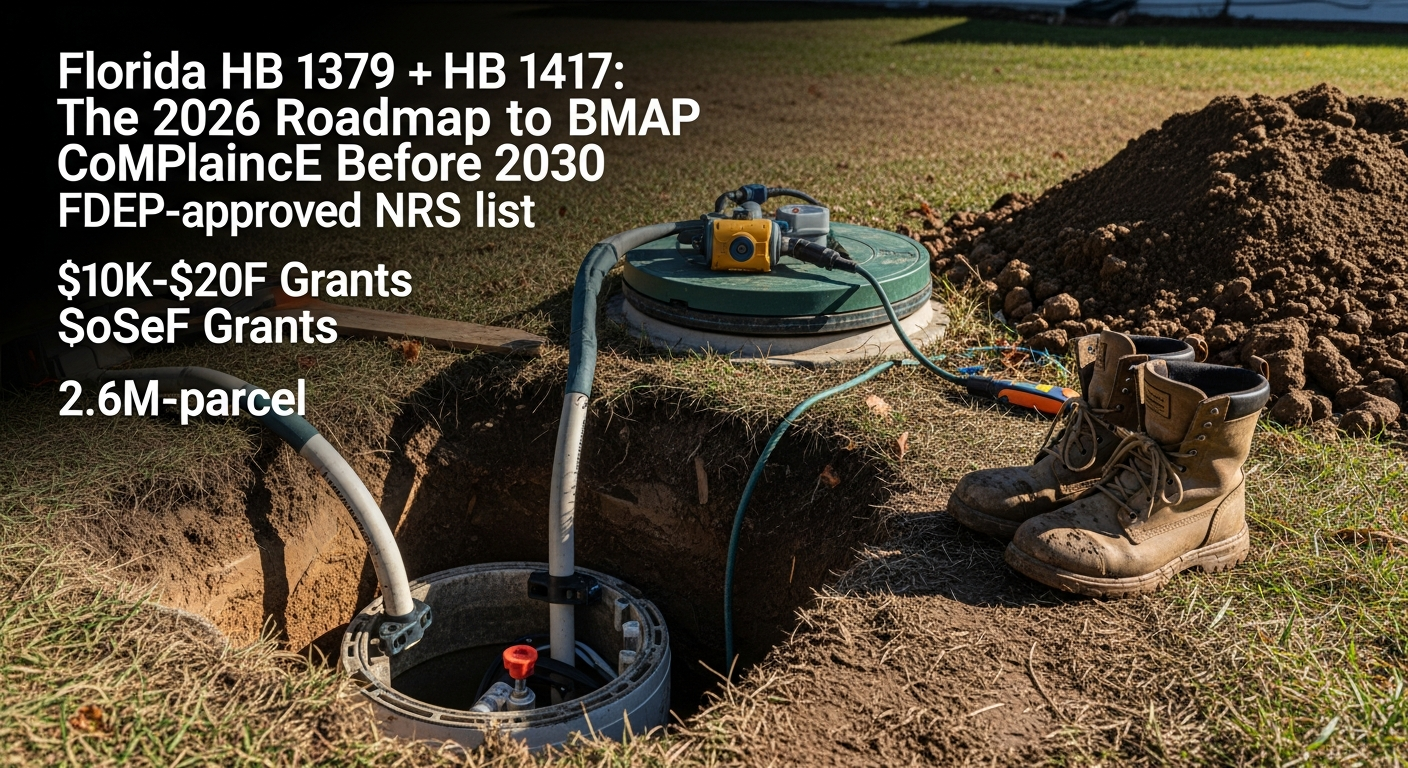
Florida HB 1379 + HB 1417: The 2026 Roadmap to BMAP Compliance Before 2030
Florida passed HB 1379 in 2023 and HB 1417 the same session, and the two together rewrote the on-site sewage statute (F.S. 381.0065) and Chapter 62-6 F.A.C. in ways that nobody outside the four counties closest to the Indian River Lagoon really felt until 2025. By the start of 2026 the FDEP nitrogen-reducing-system (NRS) approvals list has finally settled, the Save Our Seas grant program is funded through 2030, and the question for installers, designers, and homeowners is no longer "what will the rule look like" but "how do I sequence a BMAP-zone replacement so the 2030 cliff does not eat the project."
The cliff is real. Roughly 2.6 million septic parcels sit in or near a BMAP zone — Indian River Lagoon, Wekiva Springs, Silver Springs, Wakulla Springs, the Caloosahatchee / Lake Okeechobee complex, Apalachicola Bay, and a list of secondary basins. Of those, FDEP and DEH staff project somewhere between 350,000 and 600,000 will ultimately need an NRS install or a sewer connection by July 1, 2030 to satisfy the basin management action plan reductions. Nothing about that math gets easier as the deadline approaches; the contractor backlog is already six to nine months in Brevard and Indian River Counties.
This is the roadmap I now walk homeowners and small installers through when they sit down at the desk and ask "where do I start."
The Statutes, Stripped to What Matters
HB 1379 (codified into F.S. 381.0065(4)(a)(2) and amendments to 62-6.005 F.A.C.) is the BMAP-zone replacement statute. The operative pieces:
- Mandatory NRS or sewer for new construction in any adopted BMAP zone with a septic-source nitrogen reduction obligation. No grandfather; no rural carve-out. New build = NRS.
- Mandatory NRS or sewer at point of failure for existing systems in BMAP zones. A failed conventional system cannot be repaired in kind; the upgrade is to NRS or sewer connection.
- Mandatory NRS or sewer at point of substantial modification. Adding bedrooms, converting commercial use, or any modification that bumps the design flow into a higher tier under 62-6.008 forces the NRS upgrade.
- 2030 deadline for legacy systems in priority sub-basins of certain adopted BMAPs. The exact list of sub-basins is in the 2024 BMAP updates from FDEP — Indian River Lagoon, Caloosahatchee Estuary, Wakulla, and Silver Springs all have 2030-tagged priority parcels.
HB 1417 sits alongside as the inspection-cadence statute. It established:
- Annual inspection of NRS units in BMAP zones, by an FDEP-authorized inspector, with results reported to the local DEH.
- Five-year inspection cadence for conventional systems in BMAP zones outside the priority sub-basins.
- A standard inspection report format (the 1417 report) that overlays the existing 62-6 inspection contract.
What HB 1417 does not do, and what every homeowner asks: it does not impose annual inspection on every Florida septic system. Outside a BMAP zone, the inspection cadence is unchanged from pre-2023. Inside a BMAP zone but outside a priority sub-basin, the cadence is five-year. The annual obligation applies to the NRS units specifically.
The 2.6M-Parcel Scope
The often-cited "2.6 million" figure is the FDEP rough count of septic parcels inside the boundary of any adopted BMAP. It is not the count of parcels that will need replacement. The breakdown roughly:
- ~1.6M conventional parcels in BMAP zones outside priority sub-basins. Five-year inspection cadence. NRS upgrade triggered at failure / modification / sale-with-failure, but no calendar deadline.
- ~600K parcels in priority sub-basins with the 2030 deadline. NRS or sewer required by 7/1/2030 regardless of system condition.
- ~400K parcels already on NRS or sewer (legacy upgrades, new construction since 2018). Annual NRS inspection applies; no further upgrade required.
The 600K-parcel figure is the one that drives contractor demand and grant program sizing. At an average install cost of $18,000–$28,000 per NRS retrofit (varies by manufacturer, site conditions, and whether a tank replacement is bundled), the priority-sub-basin pipeline alone is a $12-17 billion buildout. (County-by-county pace in the Indian River Lagoon basin.)
The FDEP NRS Approval List
Approved NRS units are listed on the FDEP Onsite Sewage Program registry. The 2024 updates added several manufacturers and clarified performance-bond requirements that had been ambiguous since the 2023 statute. Approved categories:
- Performance-Based Treatment Systems (PBTS) — the older approval pathway under 62-6.028, primarily Norweco Singulair, Orenco AdvanTex AX-RT, Eljen GSF, and a handful of others. Performance bond requirement: typically $15,000 over five years.
- I/A OWTS (Florida-style) — the post-HB-1379 approval class, modeled on the SCDHS Suffolk County certification but with FDEP-specific performance criteria.
- Sewer connection — always an alternative if the parcel is within a feasible-connection distance, typically defined per BMAP as 200 ft or less.
The single most useful homeowner-side decision tool is the per-unit total cost of ownership over 15 years, including the annual HB 1417 inspection, the maintenance contract, and the energy / pump replacement budget. (NRS comparison: Singulair vs. AdvanTex vs. Biolargo vs. Eljen.) The cheapest unit to install is rarely the cheapest unit to own.
The Save Our Seas Grant — $10,000 to $20,000
The Save Our Seas Florida program (SoSeF) is the state-funded grant for BMAP-zone NRS retrofits. Funding history through 2026:
- 2023 allocation: $100M, depleted in priority counties within 14 months
- 2024 supplemental: $75M
- 2025 allocation: $125M
- 2026 allocation: $150M (current)
- Per-property cap: $10,000 standard, $20,000 in priority sub-basins of the IRL, Caloosahatchee, and Wakulla BMAPs
The SoSeF money stacks with county-level matching grants (Brevard, Indian River, and Lee Counties have run their own programs) and with USDA Section 504 loans for low-income owner-occupants. A coordinated stack can offset $25,000–$35,000 of a $30,000 install. Without the stack, the homeowner is paying out of pocket or financing.
The catch: the grant disburses on completed install, not on commitment. The homeowner has to front the install cost (or carry construction financing) and gets reimbursed after the FDEP inspector signs off. Cash-flow planning matters; the program is not a voucher.
The Month-by-Month Roadmap, 2026 → 2030
Working backwards from 7/1/2030 for a homeowner in a priority sub-basin who is starting cold:
2026 (4 years out)
- Q1-Q2: Identify whether your parcel sits in a priority sub-basin. (2030 BMAP roadmap walkthrough.) The county property appraiser overlay or the FDEP BMAP map is the source of truth.
- Q2-Q3: Soil and groundwater evaluation. If you are within 200 ft of a sewer interceptor, the conversion calculus is sewer-first; otherwise NRS.
- Q3-Q4: Submit SoSeF application while 2026 funds are open. Funded applications carry forward; unfunded ones reapply in subsequent cycles.
2027 (3 years out)
- Engineering design submitted to local DEH. Design review typically 60–90 days; complex sites or coastal setbacks can stretch to 120.
- Contractor selection. The list of FDEP-authorized installers is growing but contractor backlog in IRL counties is six to nine months in 2026 and projected to extend to 12–18 months by 2028 as demand peaks.
2028 (2 years out)
- Install. Conservative homeowners book the install in 2028 to leave a 12-month margin before the 7/1/2030 deadline.
- Annual HB 1417 inspection cadence begins on the new NRS unit at install + 12 months.
2029 (1 year out)
- Margin year. If the 2028 install slipped, the BMAP enforcement queue is still navigable.
2030
- 7/1/2030: priority-sub-basin deadline. Non-compliant parcels are flagged in the property record. Title-search visibility means buyers and lenders see the flag; the parcel does not lose marketability but it loses negotiating power.
The buyer-side analysis matters even more than the seller-side: a priority-sub-basin parcel without an NRS retrofit, sold post-2030, will absorb the install cost in the offer price. Owners who delay are paying the install cost in transaction discount.
The County-by-County Pace
By the start of 2026, the BMAP-zone pace is uneven:
- Brevard County (IRL): Most aggressive in the state. Local matching grant + tight contractor base + early enforcement. About 18% of priority-sub-basin parcels have completed NRS retrofit as of late 2025.
- Indian River County (IRL): Mid-pace. ~12% completion. Backlog forming.
- Lee + Charlotte (Caloosahatchee): Slower. ~7% completion. Sewer extension projects are competing for the same dollars.
- Wakulla: Started early (the 2010 nitrogen-reduction goal predates HB 1379) so the legacy NRS base is larger; ~25% of the priority sub-basin is already compliant. (Wakulla Springs as the template for HB 1379.)
- Marion (Silver Springs): Newest BMAP adoption. Very low completion. Owners are still in the awareness phase.
The pace gap matters for buyers running diligence: a Brevard parcel with no NRS in 2026 is a louder warning sign than a Marion parcel in the same condition because Brevard has been working the queue for three years and the legacy systems still in place are the harder ones.
The Failure Mode to Avoid
Don't let an installer book a conventional repair on a BMAP-zone parcel. I have seen three deals in 2025–2026 where a homeowner with a failed cesspool got quoted a conventional drainfield rebuild at $9,000, accepted, and then the local DEH bounced the permit because the parcel was inside the IRL BMAP and the rebuild had to be NRS. The owner was already $3,000 deep in pumping and partial excavation; the NRS quote came in at $24,000; the timeline added six months. The first step is the BMAP-zone check, not the installer's bid.
How Complos helps
Complos's BMAP zone checker overlays a Florida parcel against the current FDEP BMAP boundaries, the priority sub-basin list, the 2030 schedule, and the SoSeF grant cap by zone, so a homeowner or installer sees the full HB 1379 + HB 1417 picture before the first installer call. The cost estimator runs the install + 15-year ownership math against the FDEP-approved NRS list. Run the FL BMAP zone checker, or estimate the all-in NRS cost before you commit.