 Complos
Submitting a Title 5 Inspection in Plymouth: Article 51 Bylaw and the Plymouth-Carver Aquifer Protection
Complos · August 28, 2026
How to file a Title 5 in Plymouth when the parcel sits inside the Plymouth-Carver Sole Source Aquifer. Article 51 perc test depth, the surface-water setback overlay, and the local rules that exceed state Title 5.
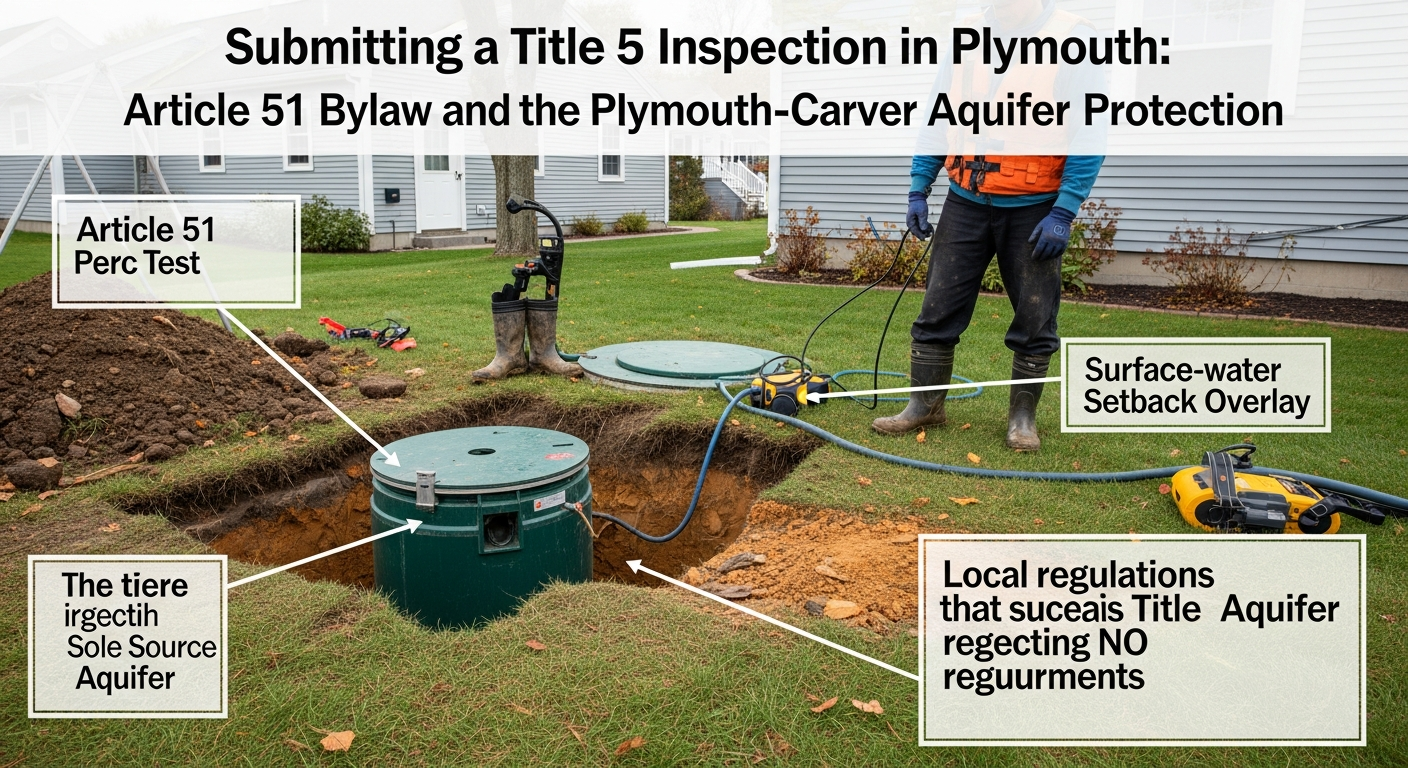
Submitting a Title 5 Inspection in Plymouth: Article 51 Bylaw and the Plymouth-Carver Aquifer Protection
By The Complos Team. Last reviewed 2026-05-14.
TL;DR. How to file a Title 5 in Plymouth when the parcel sits inside the Plymouth-Carver Sole Source Aquifer. Article 51 perc test depth, the surface-water setback overlay, and the local rules that exceed state Title 5.
You're inspecting a 1995 Colonial off Long Pond Road in Plymouth, half-acre lot, three bedrooms, conventional system installed at construction. The system passes under 310 CMR 15.302. You're already drafting the Title 5 inspection report in your head.
If the parcel sits inside the Plymouth-Carver Sole Source Aquifer — and most Plymouth residential parcels do — the state Title 5 floor is not the only standard the BOH applies. The Town of Plymouth has had Article 51 of the General Bylaw on the books in various forms since the late 1980s, and the current iteration layers stricter perc test, setback, and nitrogen-reducing-system triggers on top of 310 CMR 15.000. An inspection that ignores Article 51 reads as out-of-town.
Part of the MA Board of Health Title 5 Submission guide.
Why Plymouth-Carver Matters
The Plymouth-Carver Aquifer is an EPA-designated Sole Source Aquifer covering most of the southeastern coastal plain of Plymouth and adjacent towns. It is the drinking-water supply for tens of thousands of residents and the primary reason Plymouth's bylaw posture is conservative. The town's land-use, zoning, and BOH regulations all read as if every parcel is one bad system away from a private-well plume, because some of them are.
Practical implications for the inspector:
- The water table in many Plymouth parcels is high enough that the SAS-to-groundwater separation under 310 CMR 15.212 is the binding constraint, not the SAS sizing. Document the depth-to-groundwater observation explicitly on the Title 5 inspection report.
- Private wells are common. The 100-foot setback under 310 CMR 15.211 between the SAS and a private well is the floor; Plymouth Article 51 in some sub-areas extends that to 150 feet. Measure both your own well separation and the neighboring parcel's well separation if the SAS is near a property line.
- Surface-water bodies in Plymouth are not just rivers. Long Pond, Great South Pond, Bartlett Pond, Fresh Pond, Halfway Pond — there are dozens of kettle ponds inside the town and the Article 51 setback to surface water is enforced more strictly than the state minimum.
What's State, What's Local
The Title 5 floor under 310 CMR 15.000 applies everywhere in Massachusetts. Article 51 layers additional requirements specific to Plymouth. The pieces that come up most often at submission:
- Perc test depth — state Title 5 calls for perc tests at the SAS depth or within the design depth range. Article 51 in some Plymouth zones requires deeper testing into the groundwater zone to verify long-term hydraulic capacity. If the original 1995 design didn't follow Article 51 (and many didn't, because the bylaw kept evolving), the system can pass under the state floor but be non-conforming to local rules at any expansion.
- Surface-water setback — state minimum is 100 feet to most surface water. Plymouth in Aquifer Protection Zone II extends key setbacks; check the parcel against the town's zoning overlay before writing the SAS narrative.
- NRS triggering thresholds — Plymouth, like several coastal MA towns, requires nitrogen-reducing systems at any system replacement or expansion in defined zones. The trigger is independent of whether the current Title 5 passes.
These do not turn a passing inspection into a failure. They do mean the inspector's narrative should flag the local-rule overlay so the buyer and the closing attorney see the obligation in writing.
Submission Mechanics
The Plymouth Board of Health at 26 Court Street accepts Title 5 packages by email at [email protected] and prefers the parcel ID or property tax ID in the subject line so the agent can pull the file faster. In-person submission at Town Hall is accepted but the document goes to the same intake queue.
Expect 10-to-21-day turnaround. Plymouth has been faster than most South Shore towns on Title 5 review since they moved to digital intake, but seasonal load through the summer months pushes the queue out.
The package the BOH expects:
- Title 5 inspection report with parcel ID, sub-area (e.g., "Aquifer Protection Zone II, near Long Pond"), and well-separation distances called out
- Site plan or sketch showing tank, SAS, well, and any surface-water feature within 200 feet
- Article 51 conformance note in the narrative — a one-paragraph statement that the inspector has identified any local-rule overlay that applies and whether the system conforms
- Watershed compliance notice if the parcel feeds a watershed under TMDL (some Plymouth coastal parcels do)
The Three Rejection Patterns
1. No mention of the Aquifer Protection Zone. Plymouth's bylaw and zoning ordinance partition the town into APZ I, II, and outside-zone areas. The agent expects the inspector to identify the zone in the narrative. Skipping it does not always trigger a rejection but it triggers a clarification email and a five-to-ten-day delay.
2. SAS-to-groundwater separation undocumented. The state Title 5 inspection criteria at 15.302 require the inspector to evaluate seasonal high-groundwater conditions. In Plymouth, where the water table is high and shallow systems are common, leaving this section thin or unfilled is the fastest path to a return.
3. Missing the well separation when a private well exists on the parcel. Plymouth has a high private-well density. The agent will check the inspection against the town's well records and if your Title 5 inspection report doesn't report the separation distance, the file goes back. Measure it on site.
The Failure Mode I See
Don't tell a Plymouth seller "the system passes, you're fine" without the Article 51 conformance note in writing. The buyer's attorney will pull the inspection at closing, will read it as a clean pass, and the buyer's first contractor visit eighteen months later — when they want to add a fourth bedroom and discover the NRS trigger and the deeper perc test requirement — turns into a dispute over what the inspector knew and disclosed. The inspector's verbal "you might want to check with the town about Article 51" is not a defense.
Frequently asked questions
What's the short answer to "Submitting a Title 5 Inspection in Plymouth: Article 51 Bylaw and the Plymouth-Carver Aquifer Protection"?
How to file a Title 5 in Plymouth when the parcel sits inside the Plymouth-Carver Sole Source Aquifer. Article 51 perc test depth, the surface-water setback overlay, and the local rules that exceed state Title 5.
Who does this apply to?
NEIWPCC-certified Title 5 system inspectors in Massachusetts, FDEP-licensed septic contractors in Florida, SCDHS-permitted designers in Suffolk County NY, and the property owners these professionals serve.
Where can I read the underlying regulation?
Every Complos guide links to the source statute or rule in the body. MA Title 5: 310 CMR 15.000. FL HB 1379 / HB 1417. NY: Suffolk County Sanitary Code Article 19. Always confirm with mass.gov / flsenate.gov / suffolkcountyny.gov before acting.
How does Complos help with this?
Complos generates the regulator's exact PDF, validates the inspection against the local overlay, and tracks per-town submission methods so you don't ship the report into a black hole. Start a 14-day trial at complos.ai/signup.
How Complos Helps
Complos pre-fills the Plymouth BOH email, generates the Article 51 conformance language based on the parcel's APZ zone, and attaches the watershed compliance notice when the parcel feeds a TMDL sub-embayment. The watershed lookup tool confirms whether the parcel sits inside a regulated overlay, including the Plymouth-Carver Aquifer designation. Look up Plymouth BOH submission requirements before you send.