 Complos
MA Title 5 Inspection for a 1970s Residential Septic System: What to Expect and What It Costs
Complos · July 7, 2026
Real-world walkthrough of a Title 5 inspection on a 50-year-old septic system. What you'll find, how long it takes, compliance costs, and when replacement beats remediation.
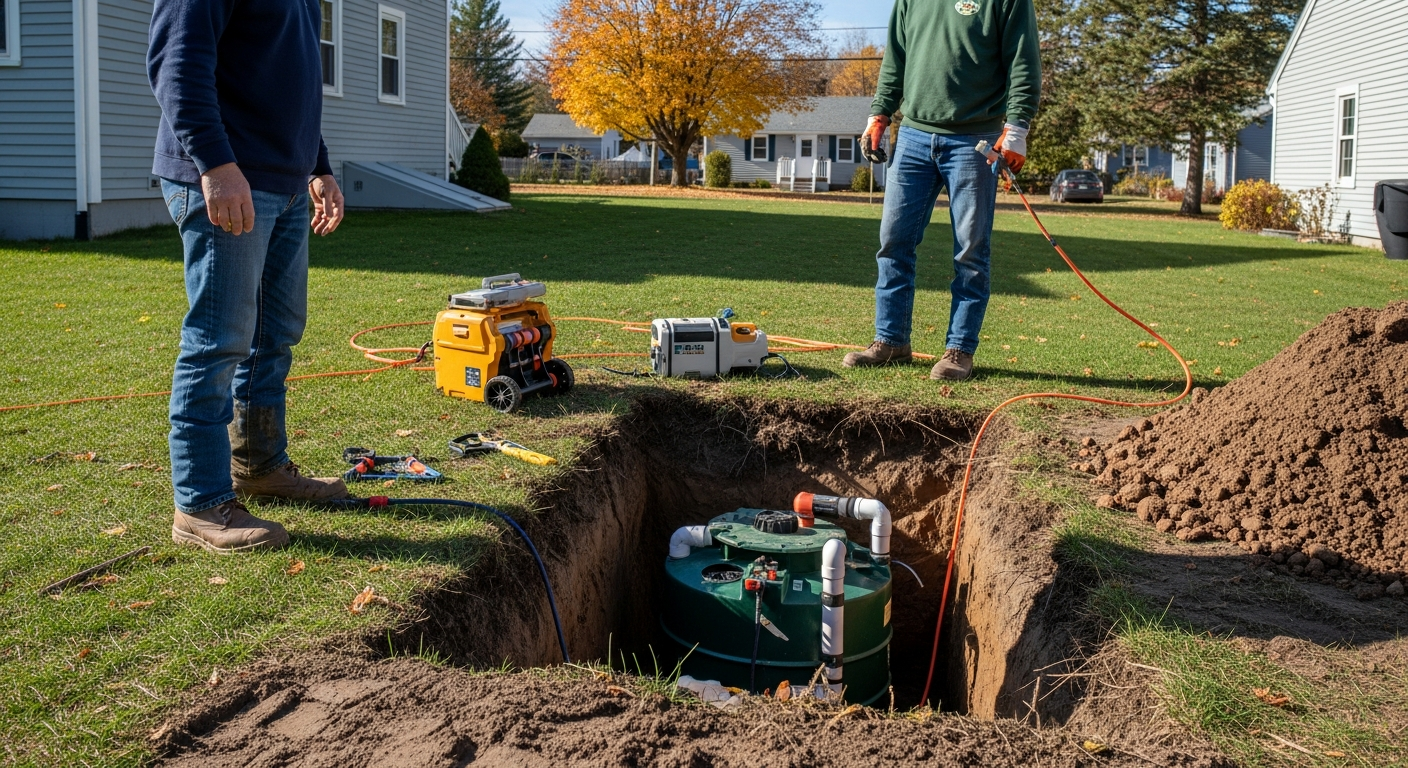
MA Title 5 Inspection for a 1970s Residential Septic System: What to Expect and What It Costs
By The Complos Team. Last reviewed 2026-05-14.
TL;DR. Real-world walkthrough of a Title 5 inspection on a 50-year-old septic system. What you'll find, how long it takes, compliance costs, and when replacement beats remediation.
You're buying a house built in 1974. The septic system is original. The inspection contingency is ticking. Your inspector says "Title 5 inspection required"—and suddenly you're asking questions: What will they find? How much will it cost? How long do I have to fix it before the sale closes?
This guide walks you through a real MA Title 5 inspection on a 50-year-old residential system—what the inspector actually checks, what failure looks like, what remediation costs, and when you're better off requesting system replacement instead.
Part of the MA Title 5 Inspection Complete Guide guide.
What a 1970s Septic System Actually Means
A system installed in 1975 has one thing working in its favor: if it's been pumped regularly and hasn't failed yet, the tank and distribution field are still performing basic functions. But "performing" doesn't mean "compliant."
Here's the problem: Title 5 standards (310 CMR 15.000) were tightened significantly after 1995. A 1970s system was installed under older rules. It probably:
- Has a single-compartment septic tank (modern systems require two chambers)
- Uses a gravity distribution field with 18" setbacks from wells (Title 5 requires 75")
- Lacks gravel fill above the absorption area
- Sits 24–36" from seasonal groundwater instead of the required 48"
- Has no distribution box to regulate flow across multiple leach lines
None of this meant the system was illegal when installed. But today, it doesn't meet 310 CMR 15.303 standards for new inspections. This is the gap every inspector finds.
Step-by-Step: The Inspection Process
A Title 5 inspector—who must be NEIWPCC certified and licensed in Massachusetts—typically spends 2–4 hours on a residential property, depending on site conditions.
Phase 1: Site reconnaissance (30–45 min) The inspector walks the property to locate the septic tank, distribution field, and any surface discharge. They measure distances from the well, property lines, and surface water. They note the soil type, topography, and groundwater depth (usually via soil pit probing with a hand auger).
For a 1970s system, they're immediately documenting violations—the tank is too close to the well, the field is uphill from groundwater, the tank access is buried under 3 feet of topsoil.
Phase 2: Tank opening and assessment (30–60 min) The inspector pumps out the tank (or you pay separately for this—typically $150–$400), then descends to inspect the tank interior, baffles, and outlet for cracks, erosion, or structural failure. They probe the tank walls with a tool that measures remaining thickness; tanks older than 40 years often show thinning from corrosion.
For a 1970s concrete tank, they'll typically note: hairline cracks (non-structural, low urgency), missing or deteriorated baffle (deficiency), or structural thinning (failure).
Phase 3: Distribution field evaluation (45–120 min) This is where most inspectors find the biggest problems. They excavate 1–3 test pits in the distribution field to evaluate:
- Soil conditions and percolation rates (is the soil fine sand or hard clay?)
- Depth to groundwater (is 48" clearance maintained?)
- Presence of septic effluent in the field (indicates system use, not necessarily failure)
- Clogging or biomat formation (a dark, smelly layer indicating overloading)
A 1970s field almost always shows biomat at the interface between the stone and soil—not a failure per se, but evidence that the field is stressed and won't last much longer.
Phase 4: Report generation (office work) The inspector synthesizes findings into the Title 5 report, which assigns each deficiency a severity code:
- No deficiency: System as-is is compliant
- Sanitary deficiency: Non-structural problem (loose baffle, cracks); remediation likely sufficient
- Structural deficiency: Tank or field compromised; replacement or major overhaul likely necessary
- Failure: System is non-functional or poses an imminent health hazard
What Most Inspectors Find on 1970s Systems
After 50 years, here's what's typical:
| Finding | Probability | Severity | Cost to Fix |
|---|---|---|---|
| Tank missing/broken baffle | 70% | Sanitary | $600–$1,200 |
| Tank structural thinning | 40% | Structural | $8,000–$12,000 |
| Field biomat/clogging | 80% | Sanitary | $2,000–$5,000 pump & jetting |
| Inadequate depth to groundwater | 60% | Structural | $12,000–$25,000 (full replacement) |
| Inadequate well separation | 45% | Structural | $12,000–$25,000 |
| Single-compartment tank | 90% | Sanitary | $3,000–$8,000 (retrofit to 2-chamber) |
Remediation vs. Replacement: The Decision Framework
When an inspector flags deficiencies, your Board of Health will typically issue one of three orders:
1. Sanitary Deficiency Only
Fix: Pump and inspect tank baffles, install deflector if missing, conduct field jetting to clear biomat. Timeline: 2–3 weeks Cost: $3,000–$8,000 Outcome: System passes reinspection for 5 years
This is the best-case scenario. Common when the tank is sound but the field is clogged.
2. Structural Deficiency (Tank or Field)
Fix: Install new tank (if old tank is thinning) or rework distribution field (if groundwater is too shallow), or both. Timeline: 6–12 weeks (requires engineering design, BOH approval, contractor scheduling) Cost: $10,000–$20,000 (new tank + field work) Outcome: System passes reinspection; 10+ year lifespan
This is common on 1970s systems because the tank or field almost always shows structural wear.
3. Failure (Imminent Health Hazard)
Example: Septic effluent surfacing in the yard, system backing up into the house, or structural collapse. Fix: Full system replacement (new tank, new distribution field, often new pump chamber for uphill discharge) Timeline: 8–16 weeks Cost: $15,000–$40,000+ (depends on site access, soil conditions, proximity to sensitive areas) Outcome: New Title 5 compliance; 25–30 year lifespan
Real Cost Breakdown for a Typical Remediation
Let's walk through what a homebuyer typical faces when a 1970s system fails Title 5:
Inspection + report: $400–$600 (NEIWPCC certified inspector) Pump-out: $150–$400 (required before tank inspection) Design/engineering (if structural deficiency): $800–$1,500 (engineer-designed system for BOH approval) BOH filing + permit: $200–$400 New tank installation: $3,000–$5,000 (materials + labor) Distribution field rework: $4,000–$10,000 (excavation, new stone, gravel, soil restoration) Reinspection: $400–$600
Total: $9,000–$18,500 for a middle-of-the-road fix (new tank, field jetting/rework, reinspection pass).
If groundwater is too shallow or the site is constrained (limited space for a new field), costs jump to $20,000–$40,000 for a full replacement.
Common Mistakes New Inspectors Make
If you're a new inspector conducting your first 1970s system evaluation, here's where the trap doors are:
1. Assuming single-compartment tanks are automatic failures They're not. A single-chamber tank can pass Title 5 if everything else complies and the field is healthy. Inspectors often over-flag this. Check the actual field performance before recommending tank replacement.
2. Finding biomat and calling it "system failure" Biomat is expected in distribution fields; it's the biological mat that actually treats effluent. It's only a problem if it's clogging the field (effluent surfacing) or creating a barrier that prevents percolation. Probe the field for saturation before writing it up as a deficiency.
3. Measuring groundwater depth on a wet site visit Seasonal groundwater varies by 12–36" depending on the time of year. Visit in spring (wet) or after heavy rain to capture the highest probable water table. Visiting in August when the water table is 6 feet down will miss a critical deficiency.
4. Not documenting tank access depth and condition If the tank access is buried under 3 feet of dirt, note it—not as a failure, but as a documented condition. The BOH will require it to be dug out and made accessible. It's a $500–$1,000 follow-on cost.
When to Push for Replacement Instead of Remediation
As a seller, you have leverage to negotiate who pays. As a buyer, you want clarity. Here's when replacement is worth pushing for:
- Tank is structurally thinning (inspector probing shows <1/4" wall thickness): Replacement, not repair. A patched old tank will fail again in 3–5 years.
- Groundwater is <36" below field: No amount of field jetting fixes this. You need a new field at the proper depth (48" clearance), which usually means a new distribution box and lateral lines. Might as well replace the tank too (money's already committed).
- Well separation <50 feet: Same issue. The field can't legally be placed closer. Full replacement required.
- System has failed before (evidence of prior repairs, patches, or failed attempts): Don't repair a failing system twice. Replace it.
Timeline: From Inspection to Closing
Assuming the BOH requires structural remediation:
- Week 1: Inspection report issued (T+5 days after inspection)
- Week 2–3: Seller/buyer agree who pays; engineer designs new system (BOH pre-approval phase)
- Week 4–5: BOH approves design; contractor mobilizes
- Week 6–10: Construction (new tank, field trenching, backfill, restoration)
- Week 11: Reinspection by Title 5 inspector ($400–$600)
- Week 12: BOH sign-off; closing proceeds
Worst case: If groundwater is too shallow or site is constrained, engineering takes 4–6 weeks and construction takes 12+ weeks. Plan accordingly in your contingency timeline.
Key Takeaway
A 1970s septic system almost always carries a Title 5 deficiency. The question isn't "will it fail?" but "how much will it cost to fix?" Most systems cost $8,000–$15,000 to remediate; some require full replacement at $20,000–$40,000+.
Use our Title 5 compliance checker to screen your system's likely status before the inspection, so you know what questions to ask and what contingency period to negotiate into your offer.
Then, once you have the inspector's actual report, our tool will help you understand the findings and prioritize next steps.
Ready to screen your system? Use the free MA Title 5 compliance checker →
Questions? Join our email list for inspector tips and MA regulatory updates →
Frequently asked questions
What's the short answer to "MA Title 5 Inspection for a 1970s Residential Septic System: What to Expect and What It Costs"?
Real-world walkthrough of a Title 5 inspection on a 50-year-old septic system. What you'll find, how long it takes, compliance costs, and when replacement beats remediation.
Who does this apply to?
NEIWPCC-certified Title 5 system inspectors in Massachusetts, FDEP-licensed septic contractors in Florida, SCDHS-permitted designers in Suffolk County NY, and the property owners these professionals serve.
Where can I read the underlying regulation?
Every Complos guide links to the source statute or rule in the body. MA Title 5: 310 CMR 15.000. FL HB 1379 / HB 1417. NY: Suffolk County Sanitary Code Article 19. Always confirm with mass.gov / flsenate.gov / suffolkcountyny.gov before acting.
How does Complos help with this?
Complos generates the regulator's exact PDF, validates the inspection against the local overlay, and tracks per-town submission methods so you don't ship the report into a black hole. Start a 14-day trial at complos.ai/signup.