 Complos
Septic System Cost Comparison: Conventional vs. I/A OWTS vs. Mound (2026)
Complos · June 2, 2026
Cost breakdown by system type. When to choose conventional tank+field vs. advanced treatment (I/A OWTS) vs. mound systems. Installation, maintenance, and lifecycle costs.
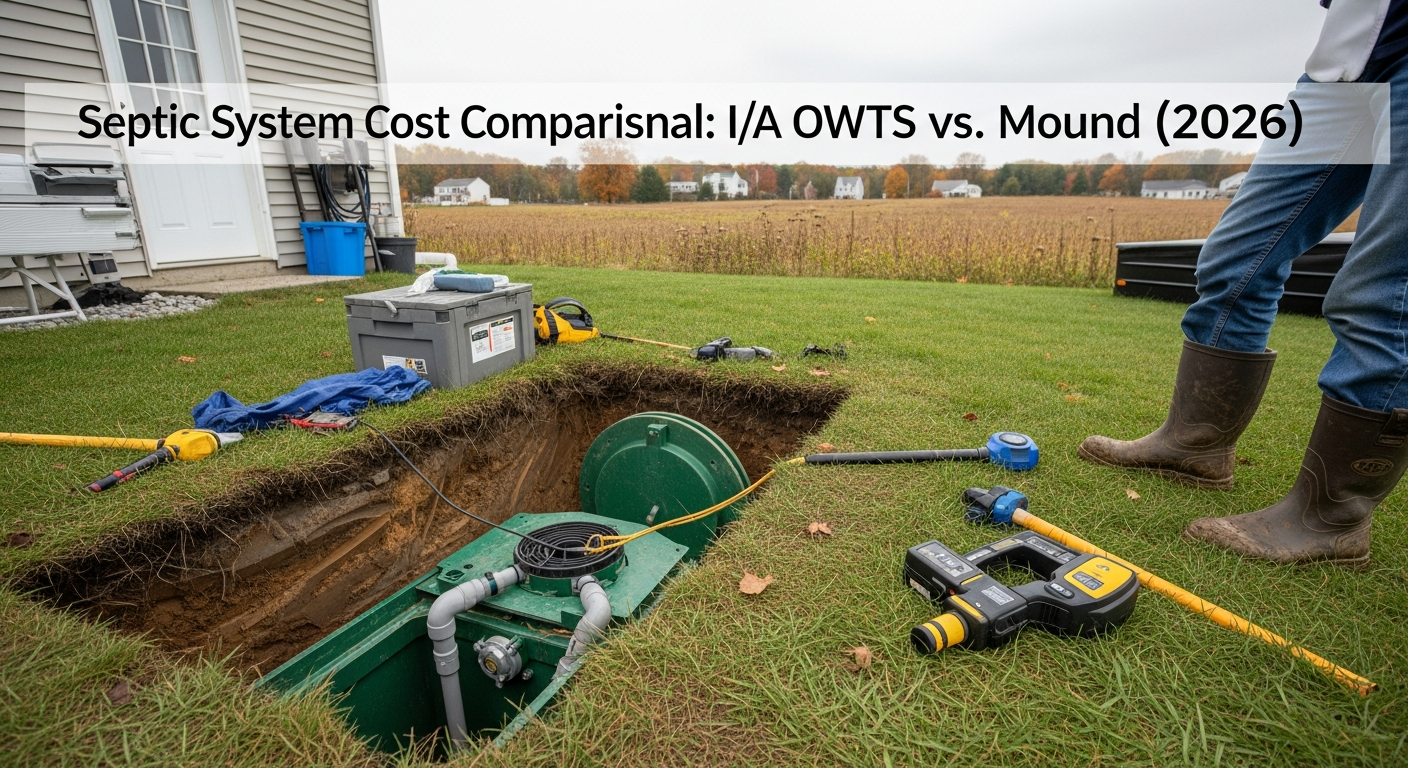
Septic System Cost Comparison: Conventional vs. I/A OWTS vs. Mound (2026)
By The Complos Team. Last reviewed 2026-05-14.
TL;DR. Cost breakdown by system type. When to choose conventional tank+field vs. advanced treatment (I/A OWTS) vs. mound systems. Installation, maintenance, and lifecycle costs.
Your engineer says you need either a conventional gravity-fed system, an I/A OWTS (advanced aerobic treatment), or a mound system. Your Board of Health approves all three. What's the cost difference?
The short answer: conventional = $12K, I/A OWTS = $18K, mound = $22K for a typical residential system. But lifecycle costs (maintenance, replacement, failures) swing the calculus differently.
This guide breaks down each system type's installation cost, annual maintenance burden, lifespan, and when one outweighs the other.
System Type Overview
Conventional Tank + Gravity Distribution Field
How it works: Septic tank + gravity distribution field. Soil naturally treats effluent as it percolates.
Best for: Good soil (sandy loam), adequate depth to groundwater (48"+), flat or slightly sloping terrain
Installation cost: $12,000–$18,000
Maintenance: Pump every 3–5 years (~$300–$400); occasional field jetting ($2K–$4K if clogged)
Lifespan: 25–40 years
Failure mode: Tank cracks (40+ years), field clogs (biomat buildup, not enough oxygen)
I/A OWTS (Individual Aerobic Wastewater Treatment System)
How it works: Tank with aerobic treatment chamber (uses blower to add oxygen). Effluent is highly treated (~10 mg/L BOD/TSS vs. 20–30 for conventional). Discharge can go to reduced-size field or land application.
Best for: Poor soil (clay), shallow groundwater, sensitive watersheds (BMAP zones, nutrient-impaired waters), limited space for field
Installation cost: $16,000–$22,000
Maintenance: Inspect quarterly; service annually; filter replacement ($150–$300); pump/blower maintenance ($300–$500/year); alarm monitoring ($100–$200/year)
Annual maintenance total: $500–$1,000/year
Lifespan: 15–20 years (shorter than conventional due to moving parts)
Failure mode: Blower failure (can disable system), alarm failure (system runs, but you miss problems)
Mound System
How it works: Tank → pump → raised mound of sand/gravel above natural grade. Pumps effluent up to a hillside mound that acts as the distribution field. Used when natural field can't be buried deep enough or soil is too poor.
Best for: High groundwater, clay soil, steep terrain, no space for field
Installation cost: $20,000–$30,000
Maintenance: Pump maintenance ($500–$800/year); mound monitoring (watch for settling, erosion); field jetting if clogged; blower/timer maintenance
Annual maintenance total: $800–$1,500/year
Lifespan: 20–30 years (pump fails first; field lasts longer)
Failure mode: Pump fails (system can't discharge), field erodes or settles, distribution becomes uneven
Cost Breakdown: The $12K Conventional vs. $18K I/A OWTS Case
Conventional Gravity System ($12,000–$15,000)
- Tank (concrete): $3,500
- Distribution field (trenches, stone, laterals, soil): $4,000
- Labor & site work: $3,500–$4,500
- Design/permits: $1,000–$1,500
- Total: $12,000–$15,500
I/A OWTS System ($16,000–$22,000)
- Tank (standard): $3,500
- Aerobic treatment unit (AquaKlear, Biolargo, Orenco): $4,500–$7,000
- Distribution field (smaller, may not be needed): $1,500–$3,000
- Blower, electrical, controls: $2,000–$3,000
- Labor & installation: $4,000–$5,000
- Design/permits: $1,500–$2,000
- Total: $16,500–$22,000
Mound System ($22,000–$30,000)
- Tank: $3,500
- Pump chamber & submersible pump: $2,000–$3,000
- Mound construction (raised sand bed, liner, gravel): $8,000–$12,000
- Distribution pipes & controls: $2,000–$3,000
- Labor (complex excavation, grading): $5,000–$7,000
- Design/permits: $1,500–$2,000
- Total: $22,000–$30,000
Lifecycle Cost Comparison (25-Year Lifespan)
| Cost Category | Conventional | I/A OWTS | Mound |
|---|---|---|---|
| Installation | $13,000 | $18,000 | $26,000 |
| Pump-outs (3–4 per 25 yrs) | $1,200 | $1,200 | $1,200 |
| Annual maintenance × 25 | $500 | $12,500 | $25,000 |
| Field jetting/repairs | $2,000 | $1,000 | $2,000 |
| System replacement (if premature failure) | $1,000–$5,000 | $5,000–$8,000 | $3,000–$6,000 |
| Total 25-year cost | $17,700–$22,000 | $37,700–$41,000 | $57,200–$62,000 |
| Cost per year | $708–$880/yr | $1,508–$1,640/yr | $2,288–$2,480/yr |
Key takeaway: Conventional is cheapest over time if your soil and groundwater allow it. I/A OWTS and mound systems are insurance policies against site limitations, not cost-effective if gravity works.
When Each System Makes Sense
Choose Conventional Gravity If:
✅ Soil is sandy loam (percs 15–60 minutes/inch)
✅ Groundwater is 4+ feet below field
✅ You have space for a standard field (typically 1,000–2,000 sq ft)
✅ BOH doesn't require advanced treatment (not in BMAP zone, not sensitive watershed)
✅ Budget is primary concern
Example: Rural MA property, good soil, no regulatory drivers → gravity system for $13K, save $5K vs. I/A OWTS
Choose I/A OWTS If:
✅ Soil is clay or unsuitable for gravity (percs >120 min/inch)
✅ Groundwater is shallow (2–4 feet below field)
✅ Property is in a BMAP zone or sensitive watershed (FL, NY)
✅ Limited space for field (1-acre lot, wetlands nearby)
✅ You're getting grant funding (Save Our Lagoon: $15K–$18K covers most costs)
✅ You want future-proofing (tighter nitrogen limits likely coming)
Example: Brevard County FL, property in IRL BMAP zone, Save Our Lagoon grant available → I/A OWTS for $18K, covered 100% by grant
Choose Mound System If:
✅ Groundwater is chronically high (within 2–3 feet of surface)
✅ Terrain is sloped; can't dig field horizontally
✅ Soil is very poor (tight clay, bedrock near surface)
✅ Building inspector/BOH specifically requires it
✅ No other options work (you're in a constraint situation)
Example: Mountain property, high water table, 2-acre lot too steep for field → mound system for $26K, only viable option
Annual Maintenance Burden (Often Forgotten)
This is where homeowners get blindsided. Conventional has low maintenance costs but requires discipline. I/A OWTS and mound require active management.
Conventional: $150–$200/year (if no problems)
- Tank pump-out: $300–$400 every 3–5 years (average $100/year)
- No blower to maintain, no filters to replace
- But if field clogs → sudden $3K–$5K jetting bill
I/A OWTS: $500–$1,000/year
- Quarterly inspections: 4 × $75–$100 = $300–$400/year
- Annual service call: $300–$500
- Filter replacement: $150–$300
- Alarm monitoring: $100–$200
- Blower bearing grease, electrical check: $100–$150
- Budget another $2K–$5K for pump/blower replacement every 10–15 years
Mound: $800–$1,500/year
- Same as I/A OWTS maintenance
- Plus pump seal replacement: $500–$1,000 every 7–10 years
- Plus mound settling monitoring; occasional grading to prevent erosion
- Plus plumbing to pump chamber: higher failure risk than gravity
Real-World Cost Example: The Comparison
Scenario: MA property, failed conventional system, three options
| Option | I/A OWTS | Mound | Conventional (new) |
|---|---|---|---|
| Installation | $18,000 | $25,000 | $13,000 |
| Annual maintenance | $600 | $1,000 | $100 |
| 10-year cost | $24,000 | $35,000 | $14,000 |
| 25-year cost | $33,000 | $57,000 | $18,500 |
| Why pick it? | Regulatory future-proofing; grant available | Terrain requires it; no choice | Soil is good; lowest cost |
Recommendation for typical homeowner: If soil tests good and groundwater is deep → conventional. If any doubt on soil or water table → I/A OWTS (especially in MA where Title 5 is strict and future nitrogen limits likely).
Grant Impact: I/A OWTS Economics
If you qualify for the Save Our Lagoon grant ($15K–$18K in NY/Suffolk) or similar:
- I/A OWTS net cost: $0–$3,000 (grant covers 80–100%)
- Conventional net cost: $13,000 (no grant)
In this case, I/A OWTS is net cheaper even with higher maintenance, because the grant underwrites most of the upfront cost.
Maintenance Cost Over Time: The Long Game
If you keep records, you'll see:
Conventional system, 25 years:
- Years 1–25: $100–$150/year routine pump-outs
- Year 18: Field clogs → $3,500 jetting
- Year 22: Tank develops hairline crack → $600 repair
- Total: $5,500–$7,000
I/A OWTS system, 25 years:
- Years 1–25: $600/year inspections + maintenance
- Year 12: Blower bearing replaced → $800
- Year 15: Pump seal worn → $1,500
- Year 22: System failure, partial replacement → $4,000
- Total: $15,000–$18,000
Mound system, 25 years:
- Years 1–25: $1,000/year pump + field monitoring
- Year 8: Pump seal failure → $1,500
- Year 16: Pump replaced entirely → $3,500
- Year 18: Mound settling; regrading required → $2,000
- Total: $28,000–$32,000
Over a lifetime, the gap widens.
Key Takeaway
Conventional is the low-cost leader if your site allows it (good soil, deep water table, no regulatory drivers). I/A OWTS costs 30–50% more upfront and ongoing, but buys future regulatory compliance and smaller footprint. Mound is the most expensive, but sometimes the only option for constrained sites.
The grant landscape matters: if you qualify for Save Our Lagoon or similar, I/A OWTS economics flip in your favor.
Use our cost estimator tool to compare system types for your site conditions and state regulations.
Questions on system type tradeoffs? Join our list for state-specific cost guidance →
Frequently asked questions
What's the short answer to "Septic System Cost Comparison: Conventional vs. I/A OWTS vs. Mound (2026)"?
Cost breakdown by system type. When to choose conventional tank+field vs. advanced treatment (I/A OWTS) vs. mound systems. Installation, maintenance, and lifecycle costs.
Who does this apply to?
NEIWPCC-certified Title 5 system inspectors in Massachusetts, FDEP-licensed septic contractors in Florida, SCDHS-permitted designers in Suffolk County NY, and the property owners these professionals serve.
Where can I read the underlying regulation?
Every Complos guide links to the source statute or rule in the body. MA Title 5: 310 CMR 15.000. FL HB 1379 / HB 1417. NY: Suffolk County Sanitary Code Article 19. Always confirm with mass.gov / flsenate.gov / suffolkcountyny.gov before acting.
How does Complos help with this?
Complos generates the regulator's exact PDF, validates the inspection against the local overlay, and tracks per-town submission methods so you don't ship the report into a black hole. Start a 14-day trial at complos.ai/signup.