 Complos
Suffolk County I/A OWTS Mandate 2026: Save Our Lagoon Grants and the Real Replacement Cost
Complos team · June 1, 2026
Suffolk County Article 19 in 2026: I/A OWTS triggers, the Save Our Lagoon $20K grant, NYSSRF stacking, the 15-year ownership math, and the 2030 priority-watershed cliff.
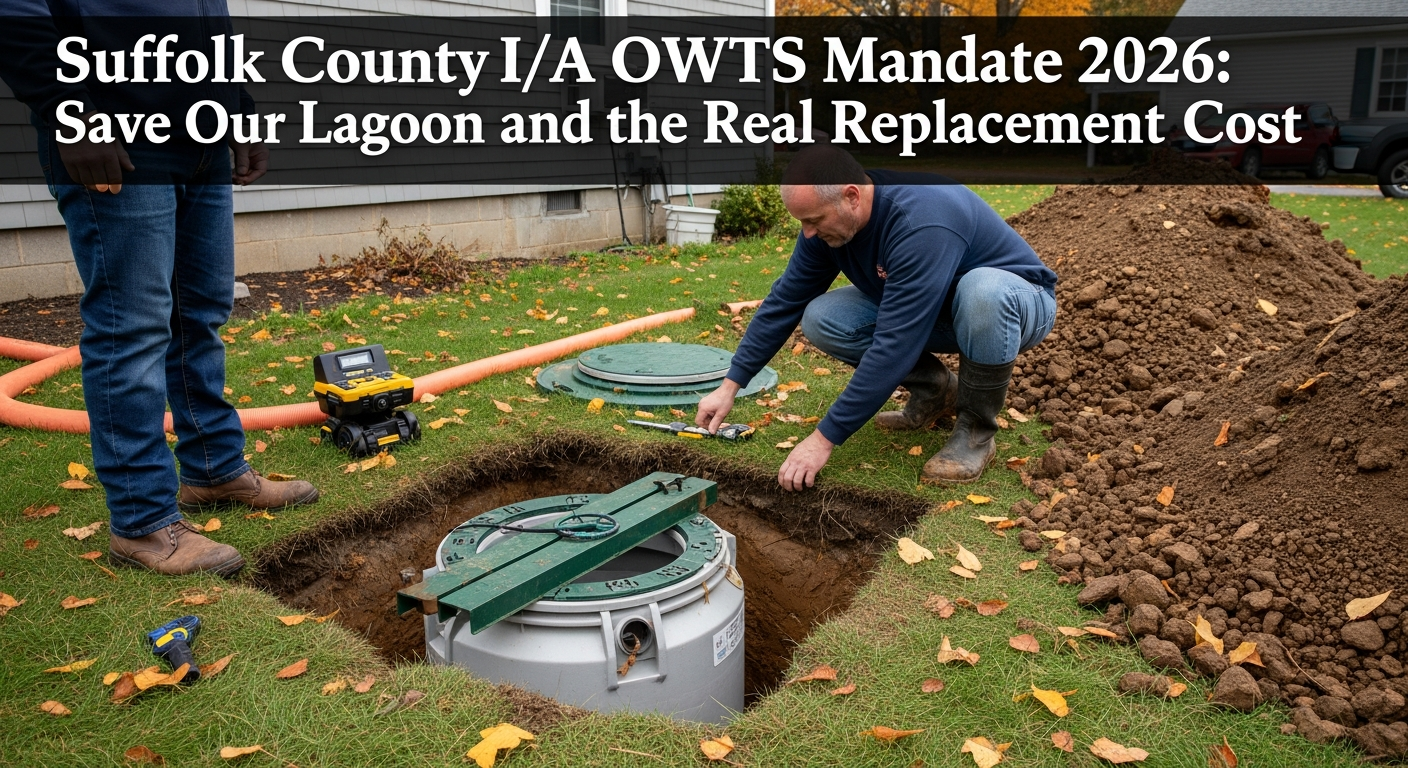
Suffolk County I/A OWTS Mandate 2026: Save Our Lagoon Grants and the Real Replacement Cost
Suffolk County's I/A OWTS mandate has been in force since July 1, 2021 and the question I get most often in 2026 is the same one I got in late 2021: "is this actually going to be enforced." The answer in 2026 is unambiguously yes. The Suffolk County Department of Health Services (SCDHS) has flagged about 4,200 parcels in priority watersheds with formal compliance notices since the 2024 amendments to Article 19 of the Suffolk County Sanitary Code took effect, and the 2030 deadline that closes the priority-watershed window is now four years out.
I run an I/A OWTS design practice on the South Shore. The volume on my desk in 2026 splits four ways — new construction, voluntary priority-watershed retrofits with the $20,000 SoLR cap, trigger-event retrofits (the bedroom addition, the change of use, the failure-driven replacement), and the buyer-diligence retrofits where the buyer's attorney finds the cesspool in title and prices the upgrade into the offer. The voluntary tier is shrinking and the trigger and buyer tiers are growing, which is what you would expect four years into a seven-year mandate.
This is the long-form version of the conversation I have with owners and small builders before I open AutoCAD.
What Article 19 Actually Mandates in 2026
Article 19 §760-1601 et seq. is the Suffolk-specific I/A OWTS mandate, and the operative section for trigger events is §760-1607. (Full Article 19 compliance walkthrough.) The four triggers that come up constantly:
- Any new construction in unsewered Suffolk County. No lot-size carve-out, no rural exception. New residential or commercial = I/A OWTS install.
- Any change of use that increases design flow. Adding a bedroom to a 3-bedroom house pushes design flow from 330 gpd to 440 gpd under the SCDHS Standards for Approval and forces I/A.
- Any failed conventional system in a priority watershed. Failure under SCDHS criteria — effluent breakout, hydraulic overload, structural collapse — triggers I/A replacement, not conventional repair.
- Any ground-disturbing renovation that triggers permit re-issuance within proximity of the existing SAS. The pool, the deck, the new well — these are the "I didn't think this affected my septic" moments that pull the system into compliance review.
The pre-2021 conventional system on a non-priority parcel that has not failed and is not being expanded is grandfathered under §760-1605(b). Owners can keep operating it; they can do like-for-like repairs (replace a baffle, re-set a D-box, re-bed a 4-foot run of distribution pipe); they can sell the property without the transfer alone triggering I/A. What they cannot do is defer indefinitely if the parcel sits in a priority watershed, because the 2024 amendments wrote a 2030 deadline into the priority-watershed schedule.
The Priority Watersheds and the 2030 Cliff
The priority watersheds named in the 2024 amendments are five South Shore / East End basins:
- Forge River
- Carlls River
- Carmans River
- Connetquot River
- Mill Pond
- Plus the Peconic Estuary tributaries on the East End
Inside these basins, the schedule reads roughly:
- 2026–2027: Voluntary compliance window. Maximum $20,000 SoLR cap for priority-watershed parcels (vs. $10,000 for standard zones). Funding is currently open and not exhausted, but is allocated annually.
- 2028: SCDHS sends individual notice to legacy-system owners in priority watersheds. The notice records the system on the property record and starts the formal compliance clock.
- 2030: Conventional systems in priority watersheds that have not been replaced with an I/A OWTS, connected to public sewer, or formally exempted (extreme hardship + occupancy waiver under §760-1611) go into the SCDHS enforcement queue. The property record is flagged in title.
A flagged record does not block a sale. It means every conventional buyer's lender and every cash buyer's attorney sees the flag at closing and prices the I/A retrofit into the offer. The owner who waited until 2030 isn't avoiding the cost — they're letting the buyer pocket the SoLR grant they could have claimed themselves.
The Real Cost: Install + 15-Year Ownership
The single most important number I share with owners is not the install cost — it's the 15-year all-in. The installation is one check; the maintenance contract, the operating permit renewal, the quarterly monitoring, and the eventual blower or pump replacement are 15 years of smaller checks that add up.
For a typical SCDHS-approved I/A OWTS unit on a residential parcel in 2026, the math runs roughly:
- Install cost — $24,000 to $38,000 depending on unit, site conditions, and tank-bundle decision. Coastal sand sites are the cheapest end; clay loam with deep groundwater on the North Shore is the expensive end. (Full I/A OWTS cost breakdown for Suffolk County.)
- Annual maintenance contract — $325 to $650 per year, mandated under the SCDHS approval. Contract must be with a SCDHS-recognized maintenance provider; many manufacturers (Norweco, Hydro-Action, BUSSE) require their own factory-trained service for warranty validity.
- Quarterly monitoring + lab fees — $400 to $700 per year for the SCDHS-required sample collection and analysis. Some units have permanent monitoring fittings; others require pump-truck access.
- Annual operating permit renewal — $200 to $300 per year, paid to SCDHS.
- Blower / pump replacement — every 7 to 10 years on most units; $800 to $2,200 per replacement.
- 15-year total ownership — adds roughly $14,000 to $22,000 on top of the install.
So a $30,000 install becomes a $44,000–$52,000 15-year program, before any inflation in the maintenance contract. This is the number that should be on the kitchen table when the owner is making the install-now-vs-defer decision.
Stacking SoLR + NYSSRF
The funding side has gotten meaningfully more usable in 2024-2026 once the New York State Septic System Replacement Fund (NYSSRF) clarified its stacking rules with Suffolk's SoLR program.
- Save Our Lagoon (SoLR) — Suffolk County program. $10,000 standard zone, $20,000 priority watershed. Disbursement on completed install, after SCDHS final inspection. Income limits in current 2026 cycle: $250,000 household for the standard tier, no income cap for the priority-watershed tier in eligibility but household-tier prioritization in funding decisions.
- NYSSRF — New York State program administered through the Environmental Facilities Corporation. Up to 50% of project cost capped at $10,000 in most counties; Suffolk's allocation has historically been the highest in the state.
- Stacking — NYSSRF caps at $10,000; SoLR caps at $20,000 in priority watersheds. Maximum combined offset for a priority-watershed parcel is $30,000, against an install cost typically $24,000–$38,000. The math can fully cover install for a typical Forge River or Carmans River retrofit.
The catch on stacking is documentation and timing. NYSSRF requires the design submission and contractor commitment before disbursement; SoLR requires SCDHS final inspection. The application sequence has to be planned so the NYSSRF money disburses against construction draws and SoLR closes at final inspection. Owners who try to apply for both after the install is finished routinely lose the NYSSRF eligibility because the funding agreement has to be in place pre-construction.
The 12% First-Review Rejection Rate
SCDHS rejects about 12% of Article 19 designs on first review. The rejections are not random; they cluster around five recurring errors that every new I/A designer makes. (Top 5 SCDHS design rejection patterns.)
In rough order of frequency on rejections I have seen:
- Setback math error — distance from the SAS to the property line, the well, the surface water resource, or the foundation drain calculated against the wrong reference point.
- Hydraulic loading rate error — applying the conventional Suffolk loading rate table to an I/A SAS, which has a different loading rate per the unit's SCDHS approval letter.
- Wrong unit specification for the design flow — picking a Hydro-Action AP-500 for a 4-bedroom (440 gpd) when the unit is approved up to 500 gpd nominal but the SCDHS-allowed design flow caps lower.
- Tank bundling error — assuming a new I/A unit replaces the existing septic tank when the design actually requires a new SCDHS-spec primary tank ahead of the I/A treatment unit.
- Soils data mismatch — the soils report from the site evaluator doesn't match the test-hole data on the design drawing because the designer translated USDA series labels instead of using the SCDHS approval-specific soils framework.
The 12% rejection rate translates to about a 30-day setback on the project timeline plus a $400-$800 redesign fee. A clean first submission is worth the engineer's hourly cost on prep.
What Buyers Need to Diligence
Suffolk County does not have a point-of-sale upgrade rule equivalent to MA Title 5 — the transfer itself does not trigger I/A. What matters at closing in 2026 is:
- Is the parcel inside a priority watershed? If yes and the system is conventional, the 2030 deadline is in play and the buyer is buying that obligation.
- Has SCDHS sent a notice on this property? Notices show in the SCDHS records. A noticed parcel is on the formal compliance clock.
- Is the existing system I/A? If yes, the buyer is inheriting an active operating permit, an active maintenance contract, and a record of monitoring submittals. Any gap in monitoring is a buyer's-attorney issue.
- What's the soil + setback profile of the parcel? A buyer-side I/A retrofit on a constrained lot can run $35,000–$50,000+ if the existing tank location forces a redesign of the SAS layout.
The Failure Mode to Warn Owners About
Don't pull a renovation permit before mapping the I/A trigger. The Center Moriches case I see every year goes like this: owner pulls a deck or addition permit, breaks ground, and then finds out the existing cesspool is now non-compliant for the new design flow. The town BOH stops construction; the SCDHS sanitarian opens a file; the owner sits on a half-built deck for four months waiting for an I/A design and install. The trigger map is the first conversation, not the third — before the building permit, before the contractor is on site, before the expedited timeline assumption is baked into the budget.
How Complos helps
Complos's SCDHS grant-eligibility tool overlays a Suffolk parcel against the priority-watershed map, the current SoLR cap by zone, the NYSSRF stacking rules, and the §760-1607 trigger tree, so an owner sees the Article 19 picture before they sign a renovation contract or accept a buyer's offer. The cost estimator runs the install + 15-year ownership math against the SCDHS-approved I/A unit list. Run the SCDHS grant eligibility check for any Suffolk parcel inside or near a priority watershed, or estimate the all-in I/A cost before committing.
Join our list for Suffolk Article 19 and SoLR program updates.