 Complos
Title 5 System Failure: What Triggers It, What It Means, and What Comes Next
Complos · June 9, 2026
Understanding Title 5 failure verdicts. What counts as a failure vs. structural/sanitary deficiency. Enforcement actions, emergency orders, and timelines for fixes.
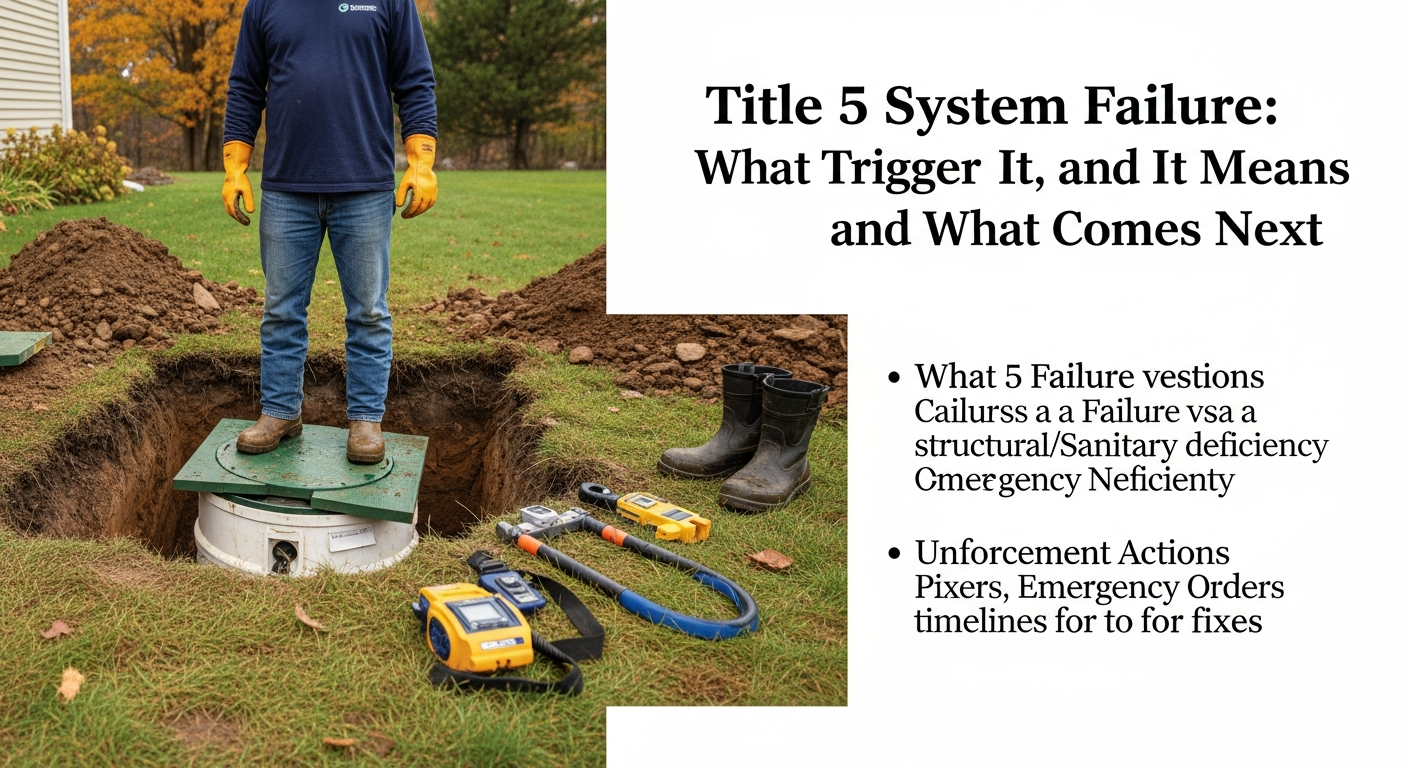
Title 5 System Failure: What Triggers It, What It Means, and What Comes Next
By The Complos Team. Last reviewed 2026-05-14.
TL;DR. Understanding Title 5 failure verdicts. What counts as a failure vs. structural/sanitary deficiency. Enforcement actions, emergency orders, and timelines for fixes.
Your septic system just failed a Title 5 inspection. The inspector's verdict reads: "Failure"—not a deficiency, not a conditional pass, but an outright failure.
This is the worst-case verdict, and it usually means your system is non-functional or poses an imminent health hazard. This guide explains what triggers a failure verdict, what the Board of Health does next, and your timeline to resolve it.
Part of the MA Title 5 Inspection Complete Guide guide.
What Counts as "Failure" Under Title 5?
Title 5 (310 CMR 15.000) defines failure as one of these conditions:
1. Effluent Surfacing in the Yard
Sewage or gray water is visible above ground in the septic field or nearby area. This means the soil isn't absorbing the discharge anymore—system is overloaded or field is clogged.
What causes it: Field biomat layer has become so thick it's blocking percolation; groundwater rose above field; or soil percolation is slower than design assumed.
Severity: Immediate health hazard (exposure to untreated sewage).
2. System Backing Up Into the House
Sewage or gray water appears in sinks, toilets, showers, or drains. This means the tank is overfull or the gravity flow from tank to field is blocked.
What causes it: Tank structurally damaged (cracks, collapsed outlet), distribution box clogged, or field completely saturated.
Severity: Immediate health hazard; poses contamination risk.
3. Structural Collapse of Tank or Field
Tank is cracked (large fractures, not hairlines), has holes, or the outlet baffle/inlet has disintegrated. Field has collapsed trenches or broken distribution pipes visible.
What causes it: Age (tank >40–50 years), corrosion, freeze-thaw damage, or equipment running over the field.
Severity: System is non-functional; immediate replacement needed.
4. Imminent Health Hazard (Catch-All)
Inspector deems the system poses an immediate threat to public health. Examples: system 10 feet from a well, septic tank in a flood zone actively flooding, or evidence of cross-contamination with drinking water.
What causes it: Poor siting decisions, extreme weather, or system design violation.
Severity: May require immediate disconnection or isolation of the system.
How Title 5 Failure Differs from Structural/Sanitary Deficiency
| Verdict | Condition | Timeline to Fix | Can You Live There? |
|---|---|---|---|
| No deficiency | System complies with Title 5 | N/A | ✅ Yes |
| Sanitary deficiency | Minor issue (loose baffle, clogged field) | 30–60 days | ✅ Yes (until BOH order) |
| Structural deficiency | Tank/field compromised but not non-functional | 30–90 days | ⚠️ Yes, but BOH may issue order to fix |
| Failure | System non-functional or imminent hazard | Immediate (1–7 days) | ❌ No (property may become uninhabitable) |
What Happens After a Failure Verdict
Step 1: Inspection Report Filed (Day 1)
The inspector submits the Title 5 report to the Board of Health, marked "Failure." The BOH receives it within 24–48 hours (depending on town).
Step 2: Board of Health Issues Emergency Order (Days 1–3)
The BOH must issue a legal notice, typically within 24–72 hours of receiving a failure report. This order includes:
- Description of the failure (e.g., "Effluent surfacing in septic field")
- Health hazard citation (e.g., "Per 310 CMR 15.004, system poses imminent contamination risk")
- Required action (e.g., "Immediately cease use of septic system" or "Install temporary pump-to-truck system within 7 days")
- Deadline (usually 7–14 days for emergency action; 30–60 days for permanent fix)
- Penalty (typically $100–$300/day non-compliance fine)
Step 3: You Take Emergency Action (Days 2–7)
Depending on the failure type, you have limited options:
Option A: Portable Pump Truck (Temporary Fix) If the tank is structurally sound but the field is clogged, you can rent a portable septic pump truck that comes every 2–3 days to pump the tank manually and haul the waste away. This keeps the system operational while you plan permanent remediation.
Cost: $150–$300 per pump-out; 2–3× per week = $300–$900/week
Timeline: Can be arranged within 24–48 hours
Duration: Weeks to months, while you engineer and build a new field
Option B: Bypass to Municipal Sewer (If Available) If your property is near municipal sewer lines, you can request permission to abandon the septic system and connect to sewer. Requires town approval and connection cost ($5K–$15K).
Cost: $5,000–$15,000 upfront + sewer user fees ($100–$200/month)
Timeline: 2–4 weeks for town review and connection
Duration: Permanent fix (if approved)
Option C: System Shutdown + Porta-Potty If the failure is severe and remediation will take weeks, you can:
- Have the septic tank isolated (capped)
- Install porta-potties or portable restrooms on-site
- All wastewater is trucked away
Cost: $500–$1,500 per porta-potty per month
Timeline: Can be arranged within 24 hours
Duration: Days to weeks
Step 4: Permanent Remediation Plan Due (Days 3–7)
Your engineer/contractor must submit a permanent fix plan to the BOH within 3–7 days. This includes:
- Detailed design for system replacement or major repair
- Contractor quote
- Timeline for construction
- Proof of financing (show you can afford it)
Common fixes:
- Full system replacement: 6–12 weeks
- New field + existing tank: 3–6 weeks
- Tank replacement only: 2–4 weeks
Step 5: Construction & Reinspection (Weeks 2–12)
Once BOH approves the plan:
- Contractor executes the work
- You schedule a reinspection
- Inspector verifies the fix
- BOH issues sign-off (if system now passes)
Step 6: BOH Sign-Off & Property Occupancy (After Reinspection)
Once the system passes reinspection, the BOH issues a Certificate of Compliance or Removal of Violation Notice. The property becomes marketable again and occupancy is no longer at risk.
Timeline Summary: Failure to Resolution
| Phase | Days | What Happens |
|---|---|---|
| Inspection | 0 | System fails Title 5; failure verdict issued |
| Emergency order | 1–3 | BOH issues legal notice; deadline given |
| Emergency mitigation | 3–7 | Pump truck, sewer bypass, or porta-potty set up |
| Permanent fix plan submission | 3–7 | Engineer submits design to BOH |
| BOH plan review | 7–14 | BOH approves or requests changes |
| Construction | 14–84 | Contractor builds new system |
| Reinspection | 84–91 | Inspector verifies compliance |
| BOH sign-off | 91–98 | Property is cleared; occupancy allowed |
| Total: 3–14 weeks | (depending on complexity) |
Selling a Property with a Failed System
If you discover the system has failed and you're trying to sell:
Disclose immediately to buyers (required by law in MA)
Budget for buyer credit ($10K–$30K, depending on the fix complexity)
Choose: Fix before sale or negotiate seller credit?
- Fix before sale: Takes 4–8 weeks; removes contingency risk; buyers feel safer
- Seller credit: Faster to close; buyer handles fix; risky if buyer walks
Title/financing impact: Lenders may require the system to be fixed before closing if the property is uninhabitable or at imminent risk
Insurance: Your homeowner's insurance may not cover damage from a failed septic system (check your policy)
Common Causes of Failure (How to Avoid It)
| Cause | Prevention |
|---|---|
| Old tank (40+ years) | Inspect tanks 35+ years old; consider proactive replacement |
| Clogged field from misuse | Never flush: feminine products, wipes, oils, excess grease |
| Structural damage from equipment | Don't drive heavy vehicles over septic field |
| High groundwater | Verify field depth during wet season (spring) |
| Poor soil | Do percolation test before buying; verify assumptions |
| Field designed too small | Verify original design matches household size + usage |
Key Takeaway
A Title 5 failure is a legal emergency. The BOH will mandate action within days, and the property may become uninhabitable. The fix typically costs $12K–$40K and takes 4–14 weeks. The earlier you catch problems (via inspections during property transfer), the more options you have. Once a failure is issued, you're in remediation mode with limited choices and ticking deadlines.
Worried about system status? Use our Title 5 compliance tool to screen for likely failure indicators →
Need to understand your deficiency notice? Check our BOH submission guide →
Questions about failure verdicts? Join our list for guidance on emergency actions →
Frequently asked questions
What's the short answer to "Title 5 System Failure: What Triggers It, What It Means, and What Comes Next"?
Understanding Title 5 failure verdicts. What counts as a failure vs. structural/sanitary deficiency. Enforcement actions, emergency orders, and timelines for fixes.
Who does this apply to?
NEIWPCC-certified Title 5 system inspectors in Massachusetts, FDEP-licensed septic contractors in Florida, SCDHS-permitted designers in Suffolk County NY, and the property owners these professionals serve.
Where can I read the underlying regulation?
Every Complos guide links to the source statute or rule in the body. MA Title 5: 310 CMR 15.000. FL HB 1379 / HB 1417. NY: Suffolk County Sanitary Code Article 19. Always confirm with mass.gov / flsenate.gov / suffolkcountyny.gov before acting.
How does Complos help with this?
Complos generates the regulator's exact PDF, validates the inspection against the local overlay, and tracks per-town submission methods so you don't ship the report into a black hole. Start a 14-day trial at complos.ai/signup.