 Complos
Title 5 Inspection for New Construction: Inspector Workflow & Timeline
Complos · June 11, 2026
Step-by-step workflow for conducting a Title 5 inspection on newly installed septic systems. System commissioning, startup testing, and approval signoff procedures.
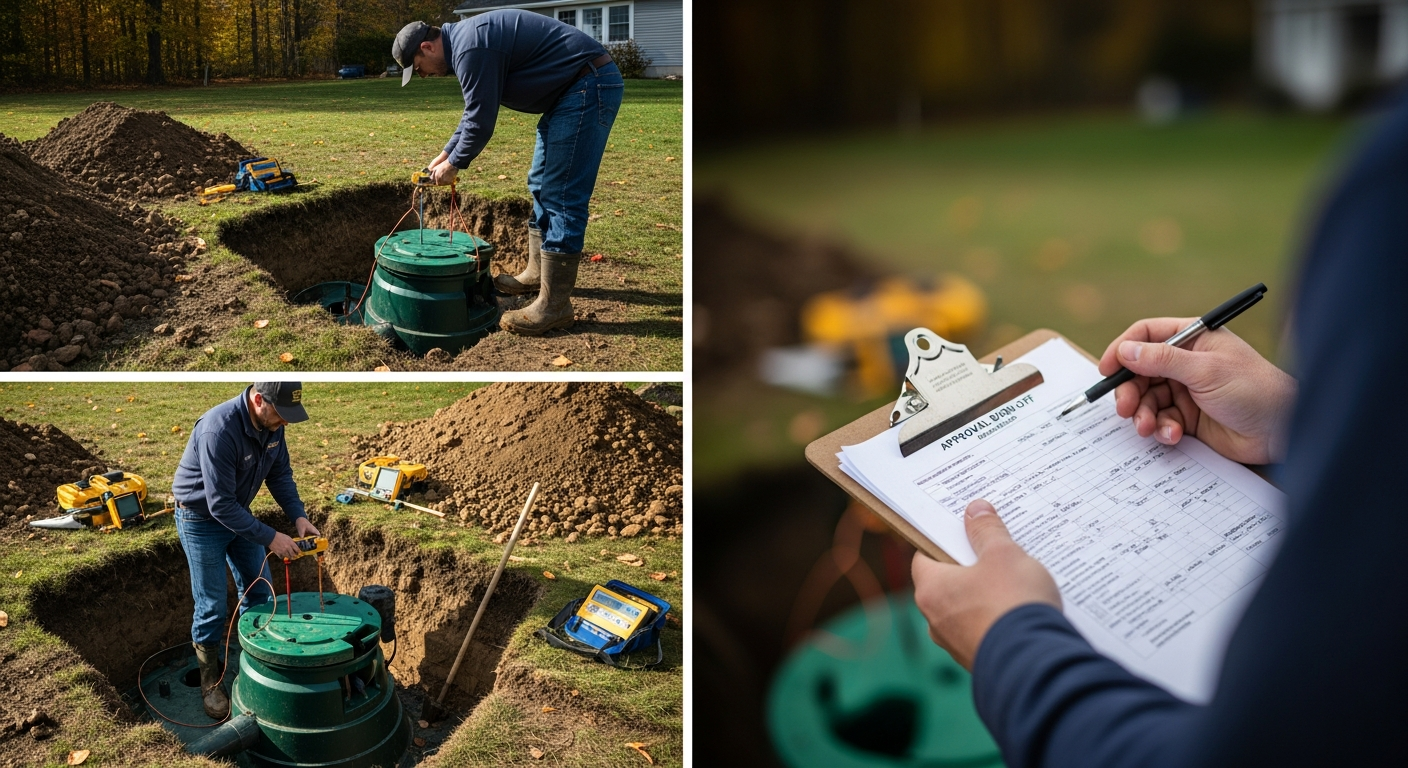
Title 5 Inspection for New Construction: Inspector Workflow & Timeline
By The Complos Team. Last reviewed 2026-05-14.
TL;DR. Step-by-step workflow for conducting a Title 5 inspection on newly installed septic systems. System commissioning, startup testing, and approval signoff procedures.
You're the NEIWPCC-certified inspector, and a new residential system just went live on a newly constructed property. The contractor calls: "System is installed and ready for your inspection." You have 48–72 hours before the Board of Health needs a sign-off for the certificate of occupancy (CO).
This guide walks through the Phase 1 (pre-startup) and Phase 2 (operational) inspection sequence for a brand-new septic system, what you're checking, common deficiencies in new work, and how to get the system through Title 5 approval in 2–3 business days.
Part of the MA Title 5 Inspection Complete Guide guide.
Why New-System Inspections Matter (And Differ from Existing Systems)
A new septic system has zero operational history. You're not checking 40 years of wear—you're verifying the design was implemented correctly and the system works as engineered before the first flush happens.
Key differences from existing system inspection:
| Factor | Existing System | New System |
|---|---|---|
| Focus | Performance history, compliance status | Installation quality, design conformance |
| Biggest risk | Failure due to age/misuse | Installation defect (wrong depth, bad soil prep, reversed outlets) |
| Timeline | 2–4 hours onsite | 4–6 hours (pre-startup + operational testing) |
| Complexity | Read existing failures | Verify design specs against field reality |
| Pass rate | 60–70% (many have deficiencies) | 85–95% (new work usually gets it right) |
Your role as the Title 5 inspector at this stage is verification and acceptance, not remediation.
Pre-Startup Inspection (Phase 1): Before Water Enters the System
You arrive before the contractor fills the tank or the homeowner flushes. This takes 1.5–2 hours.
1. Design Review & Site Verification
Start with the approved engineering design (should be on-site with the contractor). Compare it to the actual installation:
- Tank location: Is it where the plan shows? Measure distance to well, property line, water body
- Tank depth: Is the lid at or below finished grade (as designed)? Check groundwater depth at the excavation
- Distribution field layout: Are the laterals where the plan shows them? Equal spacing? Proper slope?
- Soil verification: Does the soil match the design assumptions? (Design might assume sandy loam; field shows clay—that's a problem)
- Access: Is the tank cover accessible without moving topsoil? Is the pump chamber (if present) accessible?
Common deficiency found here: Tank too deep or shallow, field slope incorrect (should be level or gentle slope, not downhill into a depression).
2. Tank & Pipe Inspection
Open the tank (ensure ventilation; watch for methane/H₂S). Check:
- Tank interior: No cracks, loose baffles, manufacturing defects?
- Tank outlets: Is the outlet baffle installed correctly? Inlet/outlet in right ports?
- Distribution box (if separate): All laterals clear? No broken/misaligned fittings?
- Pump chamber (if aerobic system): Pump installed? Air lines clear? Electrical outlet safe?
Common deficiency: Outlet baffle not fully submerged, or inlet baffle missing (contractor shipped without it).
3. Soil Absorption Field (SAF) Verification
Walk the field. Check:
- Trench bottom: Soil prepared correctly (raked, no compaction)? Stone/gravel clean (no fines)?
- Aggregate: Proper depth (typically 12–18" stone bed)? Proper stone size (typically 1–1.5")?
- Fabric & drainage: If fabric layer is present, is it properly installed (not blocking flow)? Perforated pipe level on the stone?
- Elevation: Field top at proper depth (typically 12–18" below finished grade for frost protection)? Properly sloped?
- Lateral pipes: Perforations face down? Proper spacing between runs?
Common deficiency: Field too shallow or stone bed compressed by equipment, reducing permeability.
4. Final Pre-Startup Checklist
Before water enters:
- Tank lid accessible (not buried)
- All inlet/outlet baffles installed
- No cracks or structural defects
- Distribution field top-soil not applied yet (you may need to re-inspect field after topsoil)
- Pump/aerator operational (test if aerobic system)
- No debris in field or pipes
- Contractor sign-off sheet prepared
If you find deficiencies here: Stop. Issue a deficiency notice. Don't let the contractor fill the tank. It's cheaper to fix it now than after system has been operating for a month and the field is saturated.
Operational Inspection (Phase 2): System Running
Once the contractor confirms the system is operational (tank filled, pump running, water flowing through field for 24+ hours), you schedule the Phase 2 inspection. This takes 2–4 hours.
1. System Commissioning & Startup Check
Verify the system has been running stably:
- How long has it been operational? (Minimum 24 hours; ideally 48–72 hours)
- Tank level stable? (Shouldn't be backing up into the house; shouldn't be draining out of the field)
- Pump operating normally? (Check timer/cycle counter if aerobic)
- Alarms active? (If system has high-water alarm, verify it's functioning)
Common issue found: Tank filling faster than it drains (field isn't percolating as expected); may indicate design flaw or installation issue.
2. Effluent Quality & Field Performance
After 24–48 hours of operation, the field should show:
- No surfacing effluent in the field area
- No wet spots downslope of the field
- No odor (mild earth smell OK; strong sewage smell = system overwhelmed or field failing)
- Groundwater not rising in tank (indicates field is absorbing, not backing up into groundwater)
Common problem: Field saturates quickly or effluent surfaces—usually means contractor didn't follow design (field too shallow, stone bed compressed, or soil is unsuitable).
3. Inspection of System Components
Same as Phase 1, but now you can observe:
- Tank operation: Water level stable? Scum layer forming (expected after 3–5 days)?
- Pump performance (if aerobic): Cycles regularly? Discharge clear or showing solids carryover?
- Distribution: Even flow across all laterals?
4. Soil Perc Test (If Required by Design)
Some designs require a perc test to verify field permeability matches the design assumption. If not done pre-construction:
- Dig a test pit adjacent to the field
- Fill with water, measure drawdown rate
- Compare to design percolation rate (e.g., "1 inch per 30 minutes")
- If slower than design, field may not handle the design flow; escalate
Timeline: 2–4 hours per test pit.
Common Deficiencies in New Systems & How to Handle Them
Deficiency 1: Field Too Shallow (Depth <12" Below Finished Grade)
Why it happens: Contractor wants to minimize excavation; too aggressive with backfill.
What you do:
- Issue a sanitary deficiency (field can still function, but frost protection inadequate)
- Require contractor to excavate and add topsoil/mulch layer to meet minimum depth
- Reinspect after correction
Timeline: 1–2 days to fix; reinspection 1 day
Deficiency 2: Soil Unsuitable (Clayey or Unsuitable Percolation)
Why it happens: Design was based on boring from one location; contractor's excavation reveals different soil type elsewhere.
What you do:
- If significantly different from design assumption, issue structural deficiency
- Require engineer to revise design (raised bed, engineered field, etc.)
- May require system redesign and extension timeline
Timeline: 3–7 days for revised design; 2–4 weeks for construction fix
Deficiency 3: System Not Operational (Tank Backing Up, Pump Not Running)
Why it happens: Contractor didn't properly commission; electrical not connected, pump primed incorrectly, air lines clogged.
What you do:
- Issue failure notice (system cannot be used for occupancy)
- Require contractor to fix mechanical/electrical issues
- Reschedule operational inspection once resolved
Timeline: 1–3 days for contractor to fix; reinspect immediately
Your Inspection Report for New Systems
Title 5 inspection reports for new systems differ from existing-system reports. Typical format:
Section 1: Pre-Startup Inspection Findings
- Design conformance: ✓ Pass / ✗ Deficiency
- Installation quality: ✓ Pass / ✗ Deficiency
- Soil conditions: Description + percolation rate
Section 2: Operational Inspection Findings
- System performance: ✓ Pass / ✗ Deficiency
- Field performance: ✓ Pass / ✗ Deficiency
- Pump operation (if applicable): ✓ Pass / ✗ Deficiency
Section 3: Final Verdict
- ✓ No deficiency: System approved for use
- ⚠️ Sanitary deficiency: Minor issue; must be corrected before CO; reinspection required
- ⚠️ Structural deficiency: Design flaw; requires engineering revision; extended timeline
- ✗ Failure: System non-functional; cannot issue CO
Section 4: Sign-Off
- Inspector name, license #, date
- Next inspection date (typically 5 years for Title 5; some towns require 3 years)
Timeline: From Installation to Certificate of Occupancy
| Stage | Timeline | Owner | Notes |
|---|---|---|---|
| System constructed | Day 1–10 | Contractor | Excavation, tank, field installation |
| Pre-startup inspection | Day 11 | You (inspector) | Check design conformance |
| System commissioned | Day 12–13 | Contractor | Fill tank, test pump, operate 24–48h |
| Operational inspection | Day 14 | You (inspector) | Verify performance |
| Report submitted to BOH | Day 14 | You | Same day or next day |
| BOH reviews | Day 15–16 | BOH | Typically same-day or next-day approval |
| CO issued | Day 16–17 | Building official | Once BOH approves Title 5 |
Best case: 16–17 days from construction start to CO
With one deficiency: 21–28 days (add time for contractor correction + reinspection)
With structural deficiency: 30–45 days (engineering redesign + reconstruction)
Key Differences from Existing-System Inspection
| Aspect | Existing System | New System |
|---|---|---|
| Your goal | Verify compliance, identify remediation | Verify correct installation |
| Design review | Reverse-engineer from existing system | Compare field to engineer drawings |
| Pass rate | ~65% (many have deficiencies) | ~90% (new work usually correct) |
| Most common deficiency | Tank age/clogged field | Field depth or soil unsuitable |
| Reinspection | 5 years later (transfer of property) | Typically no reinspection unless deficiency issued |
| Report complexity | Detailed findings/remediation options | Simpler: conformance checklist |
Pro Tips for New-System Inspections
Review the engineering design before you arrive — Don't be surprised in the field. Call the PE with questions.
Walk the site before the tank is filled — You can't inspect a full tank as thoroughly.
Don't accept "system just got operational" with no documentation — Ask the contractor for startup logs, pump cycle counts, or photos of initial operation.
Verify soil actually matches the design assumption — Perc test on site if uncertain. One slow-draining area can doom the design.
If anything looks wrong, stop and don't pass it — New-system deficiencies are cheaper to fix before occupancy than after months of use.
Provide clear, written deficiency notices — Contractor needs to know exactly what to fix, not "field looks weird."
Key Takeaway
New-system Title 5 inspection is verification, not remediation. Your job is to ensure the contractor built what the engineer designed and that it works correctly before the property is occupied. Most new systems pass Phase 1 & 2 with no issues; when deficiencies occur, they're usually installation errors (depth, soil prep, or commissioning) that are quick and inexpensive to fix.
Use our Title 5 compliance tool to explain the inspection framework to property owners, and to verify your inspection findings align with the regulatory standards.
Questions about new-system Title 5 procedures? Join our list for inspector-specific guidance →
Frequently asked questions
What's the short answer to "Title 5 Inspection for New Construction: Inspector Workflow & Timeline"?
Step-by-step workflow for conducting a Title 5 inspection on newly installed septic systems. System commissioning, startup testing, and approval signoff procedures.
Who does this apply to?
NEIWPCC-certified Title 5 system inspectors in Massachusetts, FDEP-licensed septic contractors in Florida, SCDHS-permitted designers in Suffolk County NY, and the property owners these professionals serve.
Where can I read the underlying regulation?
Every Complos guide links to the source statute or rule in the body. MA Title 5: 310 CMR 15.000. FL HB 1379 / HB 1417. NY: Suffolk County Sanitary Code Article 19. Always confirm with mass.gov / flsenate.gov / suffolkcountyny.gov before acting.
How does Complos help with this?
Complos generates the regulator's exact PDF, validates the inspection against the local overlay, and tracks per-town submission methods so you don't ship the report into a black hole. Start a 14-day trial at complos.ai/signup.